Fedjet 5 axis water jet cutting machines with ±10° dynamic heads. Taper-free cuts for aerospace, automotive & stone fabrication. Get a quote.
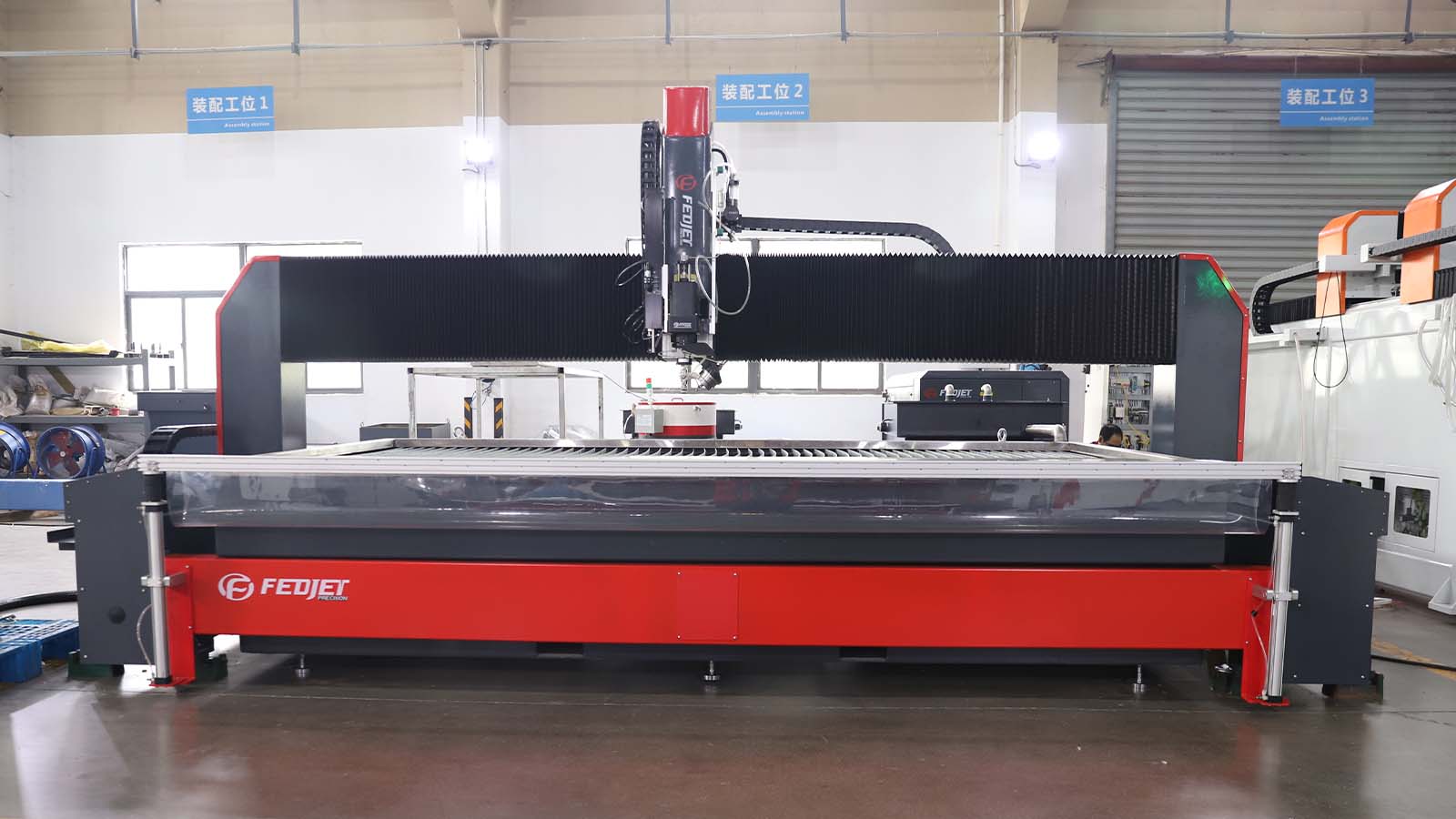
When manufacturing tolerances demand sub-millimeter accuracy on complex geometries, conventional 3-axis waterjet systems reach their practical limits. The kerf deviation that goes unnoticed on flat plate cutting becomes a critical failure point when machining beveled edges, compound angles, or 3D contoured surfaces. This is precisely where 5 axis water jet cutting machine technology transforms production capabilities.
A 5 axis CNC waterjet cutting machine adds two rotational degrees of freedom to the standard X, Y, Z traverse, enabling the cutting head to tilt and rotate while maintaining perpendicularity to the workpiece surface. The result: zero taper cuts on non-parallel faces, automatic compensation for jet lag effects, and the ability to machine bevels, chamfers, and angled through-cuts without secondary operations.
Fedjet has engineered this capability into their PowerJet G, SmartJet G, and SmartJet C series machines, paired with purpose-built 5 axis cutting heads that deliver sub-0.5° taper angles across a range of industrial applications.
Standard 3-axis waterjet cutters move the cutting head exclusively in the X, Y, and Z linear directions. When the jet strikes the workpiece at an angle—due to head tilt for piercing, normal cutting dynamics, or geometric requirements—the resulting kerf exhibits taper: wider at the top surface, narrower at the bottom. For most industrial cutting, this taper falls within acceptable tolerances. But for precision work requiring square edges on angled cuts, aerospace components with strict geometric specifications, or stone fabrication demanding seamless joints, taper becomes unacceptable.
The fundamental physics at play involves the relationship between the waterjet's velocity profile and the cut geometry. As the jet exits the mixing tube, it maintains a coherent stream for a limited distance known as the coherent length. When the cutting head tilts or the material surface isn't perpendicular to the jet, this coherent stream strikes different points along the cut face at different angles, creating the characteristic tapered profile.
5 axis water jet cutting systems address this through sophisticated motion control. By adding A-axis (tilting around X) and B-axis (tilting around Y) rotation—or C-axis rotation around the Z-axis—these systems dynamically orient the cutting head to maintain jet perpendicularity to the actual cut surface, regardless of the part's geometry.
Jet lag refers to the distance between the point where the abrasive enters the mixing tube and where the waterjet stream becomes fully developed and coherent. When cutting at an angle, this lag causes the effective cut point to deviate from the nozzle centerline, creating dimensional inaccuracies and taper.
Fedjet's 5A-Taper10 cutting head incorporates i-Telli intelligent control software that automatically calculates and compensates for jet lag in real-time. The system tracks the waterjet stream's development characteristics and adjusts head positioning to maintain precise cut geometry throughout the cutting process. This compensation reduces taper to less than 0.5 degrees—a specification that matches or exceeds many laser and plasma systems while maintaining waterjet's cold-cutting advantage.
The 5 axis water jet cutting head typically implements rotation through two of three possible axes:
A-axis rotation tilts the cutting head around the X-axis, typically allowing ±10° to ±60° of swing depending on the head design. Fedjet's 5A-Taper10 offers ±10° A-axis and ±10° B-axis capability, providing sufficient angular range for most precision fabrication requirements.
B-axis rotation provides tilting around the Y-axis, enabling the head to pitch forward and backward. Combined with A-axis rotation, this allows the system to maintain jet perpendicularity to surfaces with compound angles.
C-axis rotation provides unlimited rotation around the Z-axis, allowing the cutting head to spin continuously while maintaining the jet orientation. Fedjet's 5A-Rotary60 implements C-axis infinite rotation with ±90° A-axis deflection, enabling true 3D cutting capability for beveling, chamfering, and surface machining operations.
The most significant economic advantage of 5 axis abrasive waterjet technology is the elimination of secondary machining. Consider a typical stone countertop with mitered edges: a 3-axis system would cut the individual pieces, requiring a separate CNC router or manual polishing to create the angled edge profile. A 5 axis waterjet for stone applications cuts the bevel directly, producing finished edges in a single setup.
This single-setup capability reduces:
- Labor costs associated with handling and repositioning parts
- Equipment capital requirements (fewer machines needed)
- Overall production cycle time
- Risk of positioning errors during re-fixturing
When cutting structural steel with beveled edges for welding preparation, the quality of that bevel directly impacts weld strength and appearance. 3-axis cuts on bevels produce taper that must be compensated during welding, adding time and consumables. The dynamic orientation capability of 5 axis systems maintains consistent bevel angles throughout the cut, producing weld-prep edges that require minimal treatment before fabrication.
For composite materials used in aerospace and automotive applications, complex curvatures require multi-axis cutting capability. The 5A-Rotary60 cutting head integrates 3D functionality with precision waterjet technology, enabling the production of contoured cuts, radius bevels, and compound angle machining that would otherwise require expensive 5-axis CNC machining centers.
Taper compensation means tighter nesting tolerances. When edges don't require additional material for secondary finishing, parts can be nested closer together on the sheet or plate. For expensive materials like titanium aerospace plate or precision stone slabs, this density improvement translates directly to material cost savings.
The 5A-Taper10 represents Fedjet's standard dynamic 5 axis waterjet cutting head solution, engineered for applications requiring automatic taper compensation and precision angle cutting.
Technical Specifications:
| Parameter |
Specification |
| A-axis swing |
±10° |
| B-axis swing |
±10° |
| Dimensions |
320 × 290 × 314 mm |
| Weight |
10.5 kg |
| Control system |
i-Telli intelligent system |
| Taper compensation |
<0.5° achievable |
The compact form factor—under 11kg total weight—minimizes inertia effects during dynamic movement, enabling faster pivot speeds without compromising positioning accuracy. The 320mm × 290mm footprint fits comfortably within the envelope of Fedjet's gantry systems while maintaining adequate clearance for full angular range of motion.
The i-Telli control system manages real-time calculations for jet lag compensation, maintaining the <0.5° taper specification across varying material thicknesses and cutting speeds. This automatic compensation eliminates the need for operator expertise in taper correction—parameters that vary significantly between materials, thicknesses, and pressure levels on conventional systems.
Primary applications for 5A-Taper10:
- Stone fabrication: countertop mitering, mosaic patterns, seamless joints
- Metal processing: structural steel bevels, plate edge preparation, thick-section angle cuts
- Aerospace composites: panel beveling, edge finishing, access hole preparation
- Art glass: precision shaping, beveled edges, artistic profiles
- Ceramic and tile: complex patterns, angled through-cuts, decorative profiles
For applications requiring full rotational capability, the 5A-Rotary60 adds continuous C-axis rotation to the angular precision of the 5A-Taper10 design. This configuration enables:
- Infinite rotation around the Z-axis without cable wrap limitations
- ±90° A-axis deflection for extreme angle cuts
- True 3D cutting paths for complex surface machining
The rotary configuration suits applications including helical bevel cutting, continuous chamfering around cylindrical parts, and surface-following operations where the cutting head must track non-planar surfaces.
Both cutting heads integrate directly with Fedjet's machine portfolio, enabling customers to specify 5 axis capability as an option on new purchases or as a retrofit to existing systems.
The PowerJet G series establishes Fedjet's premium platform for high-volume precision cutting. The gantry-style construction features heavy steel framing with corrosion-resistant treatment, housed in a fully enclosed "Clean & Quiet" design that reduces operator exposure to noise and contains water overspray.
Critical specifications for 5 axis applications:
- Maximum pressure: 60,000 PSI (413 MPa)
- Positioning accuracy: ±0.02mm repeatability
- Linear accuracy: ±0.02 mm/m
- Maximum rapids: 20,000 mm/min (30,000 mm/min on traverse)
- Maximum material thickness: 200mm (metals and stone)
- Pump power: 37KW/50HP
- Control system: i-Telli PC-Based Bus Control with touchscreen interface
- Voltage: 380V/415V three-phase 50/60Hz
The 60,000 PSI pressure capability ensures adequate cutting energy for thick materials even with the slight reduction in effective pressure that occurs during angled cutting operations. The 37KW intensifier pump delivers consistent pressure across the full operating range, critical for maintaining cut quality during the dynamic movements involved in 5 axis operation.
Table configurations span X-axis travels from 2.5m to 5.0m standard, with Y-axis options extending from 1.5m up to 20m for production environments requiring long continuous cuts. Z-axis travel of 150mm to 500mm accommodates varying material thicknesses while maintaining adequate clearance for the 5 axis head assembly.
Where floor space is at a premium, the SmartJet G series delivers 5 axis capability in a space-efficient gantry design. The large-span structure integrates the cutting system components efficiently, reducing the installation footprint while maintaining precision specifications.
Precision specifications:
- Repeatability: ±0.03mm
- Linear accuracy: ±0.035mm
- Maximum rapids: 8,000 mm/min
- Continuous working pressure: 360 MPa
The reduced rapid traverse speed compared to the PowerJet G reflects the SmartJet G's positioning as a precision machine rather than a maximum-speed production platform. For operations where accuracy matters more than cycle time—aerospace tooling, medical device manufacturing, precision prototype work—this specification balance proves appropriate.
Table options range from 800mm × 800mm to 3000mm × 1000mm, with custom configurations available. The ±10° maximum swivel angle handles most bevel cutting requirements while the integrated design simplifies installation and operation.
The SmartJet C series employs a cantilever design with a monoblock cast bed, providing three-sided open access to the work area. This configuration offers distinct advantages for:
- Large part loading and unloading through the open sides
- Integration with manual or automated material handling systems
- Dual-station cutting where one side cuts while the other loads
- Complex parts requiring access from multiple approach angles
Specifications:
- Repeatability: ±0.025mm
- Linear accuracy: ±0.035mm
- Maximum rapids: 10,000 mm/min
- Continuous working pressure: 360 MPa
- X-axis travel: 2.5m to 12m available
- Y-axis travel: 1.5m or 2.0m
The longer X-axis configurations—extending to 12m—suit stone fabrication shops processing large slab materials where continuous cutting length matters more than the gantry's maximum envelope.
Fedjet's Trend series ultra-high pressure pumps provide the hydraulic power for their 5 axis waterjet systems, incorporating several technological features relevant to precision cutting:
Pressure specifications:
- Maximum working pressure: 60,000 PSI (413 MPa), with 90,000 PSI option available
- Continuous working pressure: 360 MPa
- Flow range: 1.14 to 6.8 LPM
- Motor power: 11KW to 90KW
The AIPT (Advanced Intensifier Pump Technology) integrated into Trend pumps improves hydraulic efficiency and extends seal service life—critical for maintaining consistent pressure during the dynamic movements of 5 axis cutting where demand fluctuates with head orientation and cutting depth.
The variable displacement oil pump adjusts output based on actual demand rather than running at fixed displacement, reducing energy consumption during idle periods and lower-pressure operations. Touchscreen HMI interface provides intuitive pump monitoring and parameter adjustment.
Dual pressure mode capability allows operators to switch between high-pressure cutting and lower-pressure modes for functions like pre-piercing or material settling, reducing wear on consumables during non-cutting operations.
Physical specifications:
- Dimensions: 1530 × 1230 × 1070mm
- Nozzle diameter range: 0.1mm to 0.5mm
- Voltage: 220/380/415VAC 50/60Hz
Effective 5 axis waterjet cutting requires consistent abrasive delivery. Fedjet's 210-liter capacity abrasive hopper supports 8 hours of continuous operation without refilling, ensuring uninterrupted production during critical multi-axis cutting sequences where an interrupted cut would scrap the workpiece.
The precision abrasive regulator provides 20-step flow control, enabling fine adjustment of abrasive delivery rates to match material type, thickness, and cutting speed requirements. Consistent abrasive flow maintains cutting efficiency throughout angled cutting operations where the effective cutting path length varies.
The WSS water softening system employs low-pressure nanofiltration and deionization to produce the high-purity water required for consistent jet characteristics. Impurities in feed water affect jet coherence and cutting efficiency; deionized water ensures predictable performance across varying raw water quality conditions.
The vision camera recognition system enables automatic part location and nesting optimization, particularly valuable for 5 axis operations where precise positioning affects angular cutting accuracy. Metal remnant recovery systems identify and flag material remaining after cutting, enabling efficient utilization of expensive stock materials.
Aerospace manufacturers have adopted 5 axis waterjet cutting for composite panel processing, where the cold-cutting characteristic prevents thermal damage to carbon fiber, fiberglass, and aramid materials. The ability to produce beveled edges for scarf joints and access holes without introducing heat-affected zones makes waterjet the preferred method for many airframe applications.
Titanium aerospace components benefit from waterjet's cold-cutting characteristic, eliminating the fire risk associated with thermal cutting methods in oxygen-rich environments. The 5 axis capability produces precision holes and bevels without the subsurface damage that can occur with mechanical machining of difficult-to-cut alloys.
EV battery tray production requires precision cutting of aluminum and composite materials with complex geometries. 5 axis waterjet cutting produces contoured cuts and bevels directly from CAD data, reducing tooling costs compared to progressive die stamping for short-run production volumes.
Structural automotive components benefit from precision beveled edges that improve weld quality and reduce filler metal requirements. The ability to cut to tight tolerances without secondary machining accelerates assembly operations.
The stone industry represents one of the largest application areas for 5 axis waterjet technology. Countertop fabrication requires mitered edges for the characteristic 45° joint that creates the appearance of thick stone from thinner slabs. The 5A-Taper10 produces these cuts with precision that eliminates visible seams.
Mosaic patterns and complex inlays require precision cutting of irregular shapes with exact edge quality. The 5 axis capability maintains cut quality regardless of the cut direction relative to the stone's natural grain and hardness variations.
Seamless stone joints—critical for continuous patterns across large installations—require cuts that match precisely when assembled. The <0.5° taper specification of Fedjet's 5 axis systems produces edges that fit together without visible gaps.
Structural steel fabrication requires beveled edges for quality welds. Manual grinding of bevels consumes labor hours and produces inconsistent results. 5 axis waterjet cutting produces consistent bevel angles automatically, reducing finishing labor while improving weld preparation quality.
Pipe and vessel cutting for process equipment benefits from 5 axis capability for saddle cuts and branch connections. The ability to cut accurate angles without expensive pipe-specific cutting equipment expands fabrication capability.
The relationship between pressure, flow, and cutting speed determines production throughput. Higher pressures (60,000 PSI and above) enable faster cutting of thick materials but increase operating costs. Evaluate your typical material mix and thickness requirements against available pressure specifications.
Fedjet's 60,000 PSI standard pressure handles most industrial applications including 200mm+ metal and stone cutting. The 90,000 PSI option extends capability for the most demanding thick-section applications.
Positioning accuracy and repeatability specifications must match your tolerance requirements. The PowerJet G's ±0.02mm repeatability suits precision aerospace and medical applications. The SmartJet series' ±0.025-0.03mm specifications handle standard industrial fabrication requirements at lower cost.
Match table dimensions to your largest typical workpiece with adequate clearance for 5 axis head swing. Consider:
- Part dimensions plus clearance for material handling
- Minimum part spacing for nested cutting
- Future requirements if production volume is expected to grow
- Floor space constraints in your facility
Modern PC-based control systems like Fedjet's i-Telli platform offer advantages over older standalone controllers:
- Direct import of CAD files in standard formats (DWG, DXF, STEP, IGES)
- Integrated taper compensation calculations
- Real-time cutting path optimization
- Remote monitoring and diagnostic capability
- Software updates and feature enhancements
5 axis systems require more sophisticated support than basic 3-axis machines. Evaluate:
- Manufacturer response time commitments (Fedjet offers 24-hour response with 2-hour on-site capability)
- Spare parts availability in your region
- Technical training for your operators
- Application engineering support for new cutting requirements
Waterjet cutting involves ongoing consumable expenses including:
- Orifices: typically 50-150 hour service life depending on pressure and material
- Mixing tubes: 80-200 hour service life
- Abrasive: 0.5-2 lbs per minute depending on material and thickness
- High-pressure seals: 500-2000 hour service life depending on operating pressure
5 axis cutting head seals experience more dynamic stress than stationary 3-axis seals due to continuous angular movement. Budget for more frequent seal replacement during initial operation until maintenance intervals stabilize.
Pump motor power (37KW-90KW for Fedjet Trend series) represents the largest energy cost. Variable displacement pump technology reduces consumption during partial-load operation. Consider:
- Actual operating hours versus standby time
- Pressure requirements for your typical workload
- Utility rate structures (demand charges may apply for large motors)
Scheduled maintenance for 5 axis systems includes:
- Daily: nozzle inspection, abrasive system check, water quality verification
- Weekly: seal inspection, pressure system verification, axis lubrication
- Monthly: full system calibration, seal replacement if indicated, abrasive system deep cleaning
- Annual: comprehensive system evaluation, replacement of wear items, software updates
The elimination of secondary operations provides quantifiable value:
- Reduced labor hours per finished part
- Lower equipment capital (fewer machines needed)
- Reduced scrap from re-fixturing errors
- Faster delivery through single-setup processing
Calculate the value of these improvements against the additional cost of 5 axis capability versus 3-axis systems to determine the appropriate investment level for your operation.
5 axis water jet cutting machine technology represents a significant capability advancement for precision fabrication operations. The ability to produce taper-free cuts on beveled edges, complex angles, and 3D contours eliminates secondary operations, improves quality, and expands the range of parts producible on waterjet equipment.
Fedjet's implementation through the PowerJet G, SmartJet G, and SmartJet C platforms—supported by the 5A-Taper10 and 5A-Rotary60 cutting heads and Trend series UHP pumps—delivers this capability with the precision specifications and support infrastructure industrial buyers require.
The decision between 3-axis and 5-axis waterjet should consider current and anticipated precision requirements, material mix, production volume, and the value of eliminating secondary operations from your manufacturing process. For operations already running 5-axis CNC machining centers for waterjet-suitable materials, the economic case for 5 axis waterjet is clear. For shops currently outsourcing precision beveled parts or performing manual finishing, in-house 5 axis capability often pays for itself within months.
Author: Richard
Company: Jiangsu Fedjetting Tech Co., Ltd.
Website: fedjetwaterjet.com
Certifications: CE, SGS, ISO 9001:2015, ISO 45001, ISO 14001:2015
Established: 2012 | National High-Tech Enterprise
Global Reach: 135+ countries, 3,000+ brand customers, 15+ years experience


